How to Spot Underserved Customer Groups in a Saturated Market
Every crowded market still has pockets of unmet demand. The challenge is that most businesses look in the same places, using the same criteria, and therefore miss the customers who are not well served by the dominant players. Finding those underserved segments is not about luck. It is a methodical process that combines observation, data, and a willingness to look past the obvious.
This article walks through the practical steps you can take to identify these opportunities, with specific attention to what to watch for at each stage. The goal is to give you a clear framework, whether you are running a local service business or a company with a broader reach.
Step 1: Map the existing market by demand type, not by product
Most market analysis starts with competitor categories: who sells what, at what price, to whom. That approach tends to reinforce what everyone already knows. A more useful starting point is to map the market by the type of demand that exists. People search for solutions based on their specific situation, not on product categories.
For example, a parent looking for a weekend activity for a toddler has a different set of priorities than a corporate team looking for a team-building event, even though both might end up searching for "indoor play spaces." The demand types are different: convenience and safety for the parent, capacity and booking flexibility for the corporate buyer. If every local play space targets only the parent demographic, the corporate segment is underserved.
What to watch: Look for clusters of search queries that share a common intent but receive generic results. If the top results all talk to the same buyer persona, there is likely an overlooked segment. Tools that track customer intent across search can help surface these patterns without manual guesswork.

Step 2: Analyse competitor activity for gaps in coverage
Competitor analysis is not just about seeing who ranks for which keyword. It is about understanding the full scope of what a competitor does and, more importantly, what they do not do. Most businesses focus their marketing and product efforts on the largest, most visible customer groups. That leaves smaller but still sizable groups with less competition.
Look at competitor websites, their service pages, and their content. Do they have dedicated pages or resources for specific use cases? If a competitor only addresses "small business owners" in a general way, they are likely missing the sub-segments within that group: home-based businesses, mobile service providers, single-location retailers, and multi-location franchises. Each of these has different needs around scheduling, reporting, or lead management.
What to watch: Pay attention to the language competitors use. If they consistently use broad terms like "any business" or "all companies," they are signalling that they have not specialised. That opens a door. Also note which features or services they promote heavily and which they barely mention. The features they ignore may be exactly what a specific segment needs.
Step 3: Use local search data to find geographic gaps
Even within a single market, demand varies by location. A product or service that is well covered in one neighbourhood may be nearly absent in another. Local search data reveals these differences clearly. When you look at search volume and the types of businesses that appear for local queries, you can see where the supply does not match the demand.
For instance, a city might have dozens of dog daycare centres in the downtown core but very few in the outer suburbs, even though the suburban population of dog owners is growing. The mismatch is a classic underserved segment. The same principle applies to B2B services. A certain industry cluster in one part of a metro area may have no local provider of a specific business service, forcing them to work with remote vendors.
What to watch: Look at the search results for a service plus a location modifier. If the top results are always outside the immediate area, or if the results are thin (fewer than five relevant businesses), that location is likely underserved. This is where software for finding market gaps becomes particularly useful, because it can aggregate local search data across many regions at once.
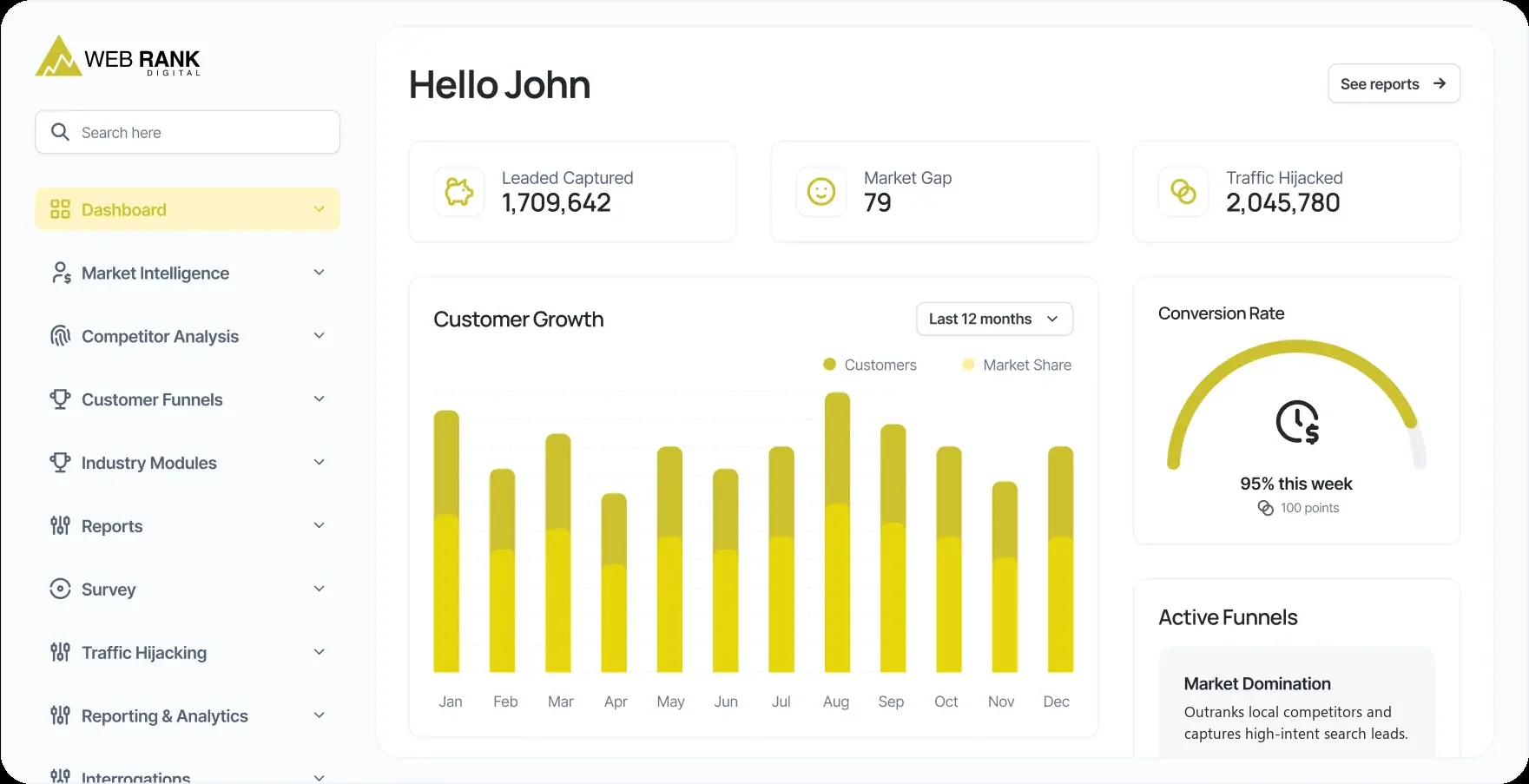
Step 4: Score opportunities by demand intensity and competition
Not every gap is worth pursuing. Some segments are underserved for a reason: the demand is too small, the customers are too hard to reach, or the unit economics do not work. Opportunity scoring helps you separate real opportunities from distractions.
Build a simple scoring system based on two dimensions: the strength of the demand (how many people are actively looking for a solution) and the level of competition (how many businesses are already serving that demand). A high-demand, low-competition segment is the ideal target. Low-demand, high-competition segments are the ones to avoid.
What to watch: Be careful not to confuse search volume with demand. High search volume for a broad term might include many different intents, not all of which match the segment you are considering. Use intent filters or look at long-tail queries to get a clearer picture. Also, consider the cost of acquisition. A segment that requires expensive advertising to reach may be less attractive even if demand is strong.
Step 5: Validate the segment with real behaviour
The final step is to confirm that the segment you have identified actually behaves the way you expect. This means looking at actual engagement data, not just search trends. If you already have a customer base, analyse it for patterns. Which customers have a high lifetime value? Which ones refer others frequently? Which ones have specific needs that your current product does not fully address?
If you do not have a customer base yet, consider small-scale tests. Run a targeted ad campaign to the segment and see how it responds. Monitor the click-through rates, the questions people ask, and the conversion path. Real behaviour will tell you more than any model.
What to watch: Watch for signs that the segment is price-sensitive or expects a level of service that would be hard to deliver at scale. Also watch for segments that seem interested but never convert. That can indicate a mismatch between your offer and their actual priority. Sometimes the underserved segment needs a different pricing model, a different delivery method, or a different communication channel.

Bringing it all together with the right tools
Doing this analysis manually across multiple markets and segments is time-consuming. That is where dedicated software for finding market gaps comes in. It can automate the data collection, surface patterns that would be easy to miss, and give you a structured view of where the opportunities lie. The best tools integrate market intelligence, competitor monitoring, and lead tracking into one workflow, so you can move from insight to action quickly.
The key is to treat the process as ongoing. Markets shift, new competitors appear, and customer needs evolve. What is an underserved segment today may be crowded next year. By regularly running through these steps, you keep your finger on the pulse of the market and stay ahead of the curve.
Start with one segment that looks promising. Test it. Learn from it. Then expand. That is how you turn a crowded market into a landscape of opportunity.